Positioning a premium private-banking alternative.
2022 – 2023 · Role: Lead Product Designer (Contract) · Tier-1 Nigerian bank · Team: End-to-end product team · Scope: Digital identity, information architecture and marketing site
Context
Signature Bank is a Nigerian bank positioning itself as a premium private-banking alternative.
It is a modern institution built to accelerate growth through technology. The goal was to move beyond the one-size-fits-all approach of Nigerian banks and build an experience as unique and secure as a fingerprint.
Challenge
The identity question: premium enough for private and institutional wealth, accessible enough for personal and digital banking.
Trust in security: in a market sensitive to fraud, the UI had to say “maximum security” without feeling cold or restrictive.
The stake: a poor digital entry point would undermine the goal of being a trusted, world-class institution.
Discovery
We researched what makes a service feel bespoke and found that people value predictive personalisation over generic features. The site shouldn’t be a list of products; it had to be an opportunity accelerator. People felt constrained by traditional banking limits, which gave us the philosophy: no restrictions, no limitations.
Approach
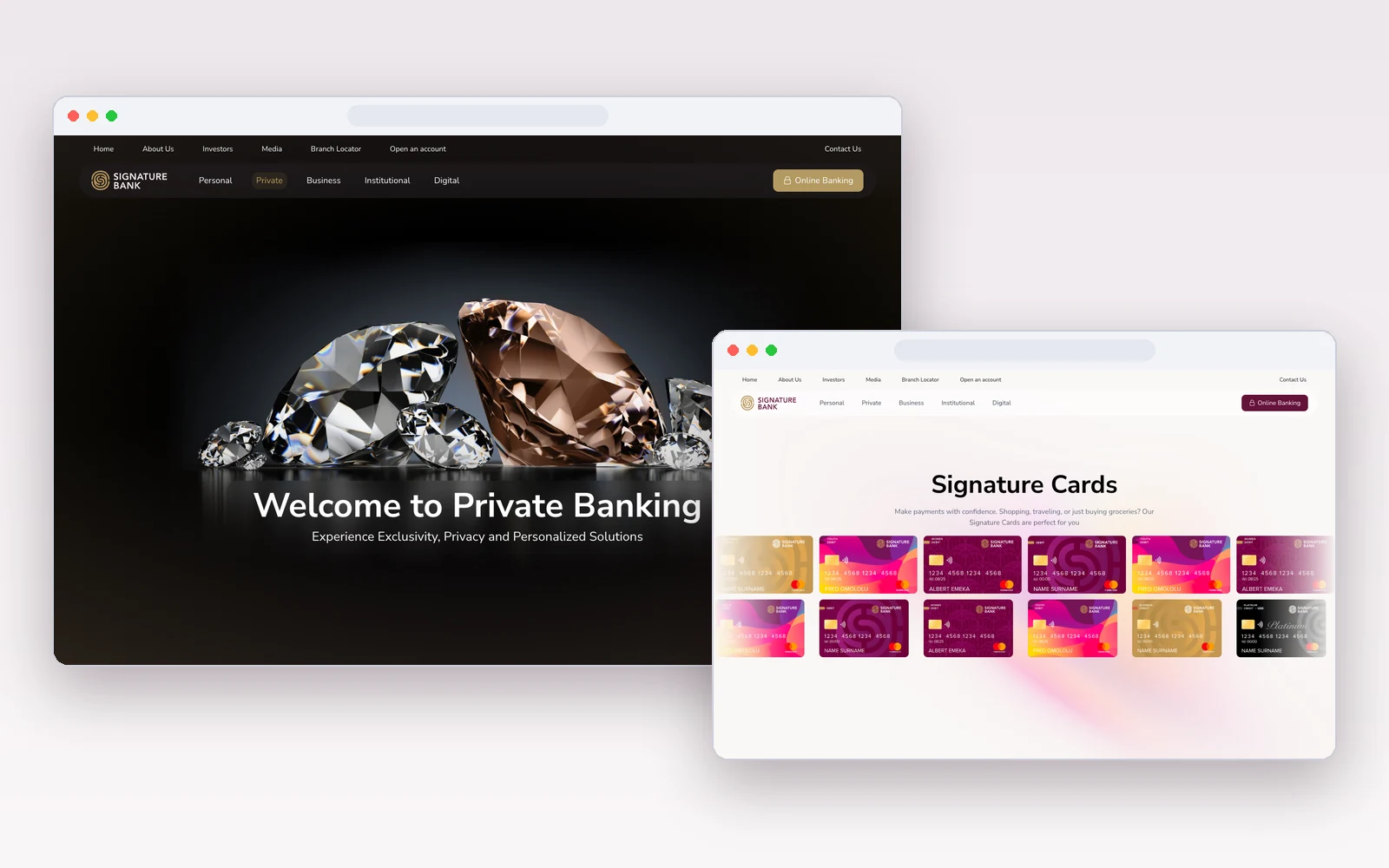
Whitespace, photography and iconography — We iterated to find the right balance of whitespace, high-end photography and custom iconography that gives the bank its personal feel.
A modular framework — One framework serves private-wealth clients and business owners without diluting the brand voice.
Kill the clutter — We removed overlapping banners and dense text for a clean, high-performance interface.
Craft
Identity, IA and the site — I led the digital identity, information architecture and marketing site rebuild that carries that positioning.
Signature cards — Specialised flows for Signature Cards that reflect the payment needs of the target audience.
A hub for every audience — A centralised hub for personal, business and institutional banking that keeps one Signature feel.
End to end — I managed the full lifecycle, from UI/UX to front-end and back-end integration, so the security promise was backed by a multi-level implementation.
Result
Signature launched as a modern, technology-led alternative to Nigeria’s top banks. The clean, secure design became the main tool for stakeholder engagement and national development visits.
Reflection
A lesson in strategic consistency. In high-end banking, design is the silent partner of security: a site this polished and intentional makes people more confident their wealth is in careful hands.
I’m , a Senior Product Designer and Design Engineer. Ten years across fintech, healthtech, commerce and logistics, from user research to production code.
I studied graphic design, led a product design team at Alerzo, and now design and build private capital software at DealStack.
My best ideas come from where products are actually used: market stalls in Lagos and Ibadan, a fund administrator’s spreadsheets, a bank’s support queue. I turn what I find there into clear, calm systems.
Then I help build them. At DealStack I coded about 90% of our design system in React, so what ships is what was designed.
User research
Interviews, field studies, usability and tree testing. I learn from what people do, not only what they say, and turn it into product decisions.
User interviews · Usability testing · Field research · Journey mapping · Analytics
Product design and systems
End-to-end product design for complex B2B and fintech software: clear flows, sound information architecture and design systems that scale.
Interaction design · Information architecture · Design systems · Prototyping · Accessibility (WCAG 2.1)
Design engineering
I prototype and build in React and TypeScript, so designs are tested against real data and what ships matches what was designed.
Recommendations from my LinkedIn profile, from a manager, a fellow designer and the marketers I’ve shipped with.
“Ayodeji’s commitment to excellence is evident in every project he undertakes. He consistently delivers high-quality designs that exceed expectations, making him an invaluable team member.”
“Working alongside Ayo was truly inspiring. His leadership in product design, coupled with his ability to bridge design and engineering, elevates the entire team’s output.”
AAAbdul-Lateef AkinyemiSenior Product Designer
“Ayodeji is an exceptional team player who brings creativity and strategic thinking to every collaboration. His ability to translate complex problems into elegant solutions is remarkable.”
“Ayo is a creative mind who consistently pushes boundaries. His design work is not just visually stunning but strategically sound, always keeping the end user in focus.”
POPromise OsigweMarketing Communications
Beyond the day job.
Mentoring, speaking, and a few companies and products of my own.
Speaking
Tech Rise Africa, to 1,000 people. DSGN Discussions, to 400+. On design leadership, product systems and creative practice.
Companies I’ve founded, and products I build in my own time.
Empocreat (The EOC) builds digital products, brands and experiences with clarity and purpose. I founded it in 2016 and have directed creative strategy for 20+ brand and product projects across fintech, education, consumer tech and e-commerce.
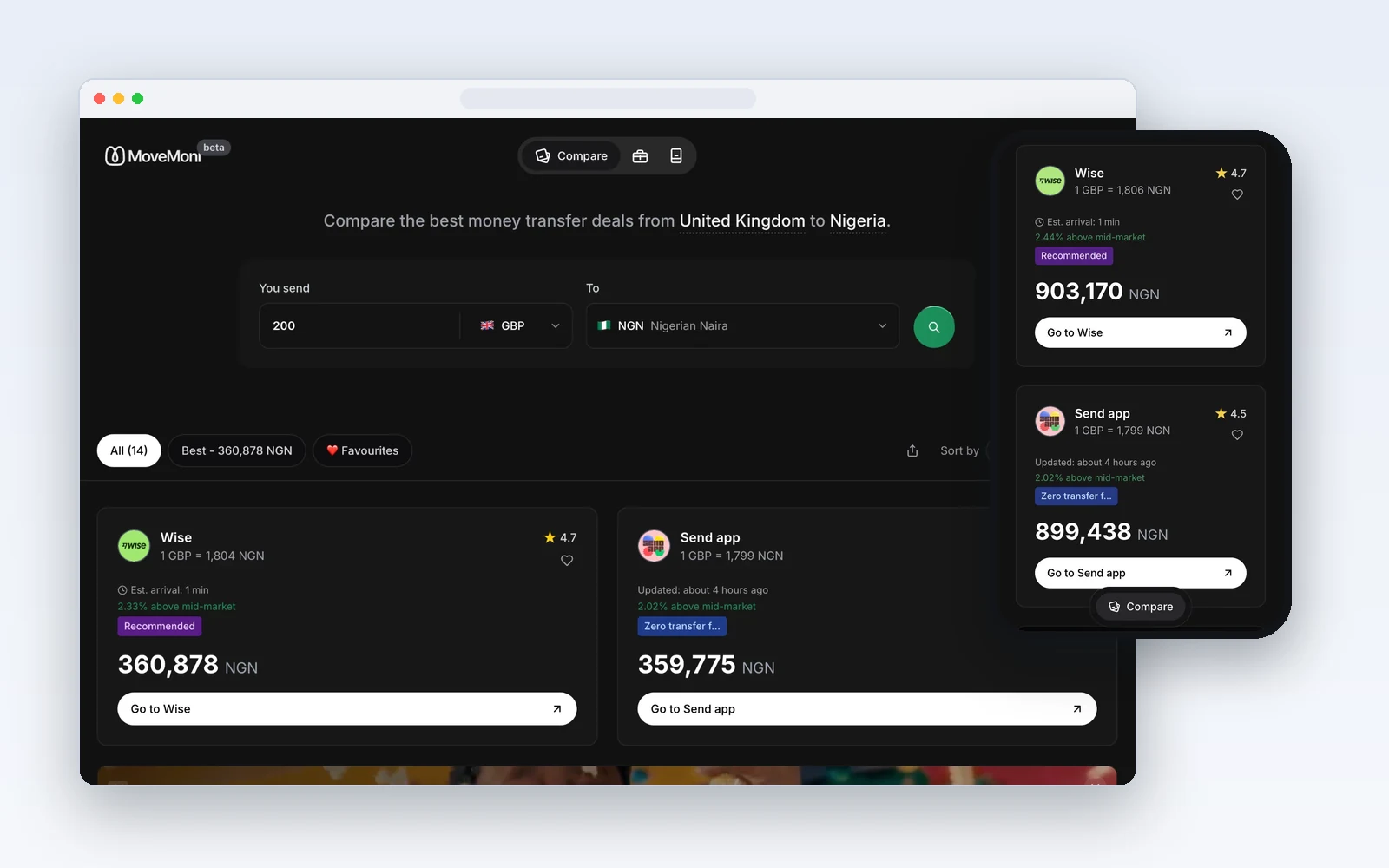
MoveMoni compares exchange rates and fees across international money-transfer providers in real time, so people can see who is cheapest for their route before they send. Users save 3–5% on average on international transfers.
Clariti is a personal finance companion that helps people track spending, budget smarter and take control of their money in one simple app. It started inside MoveMoni and now stands on its own.
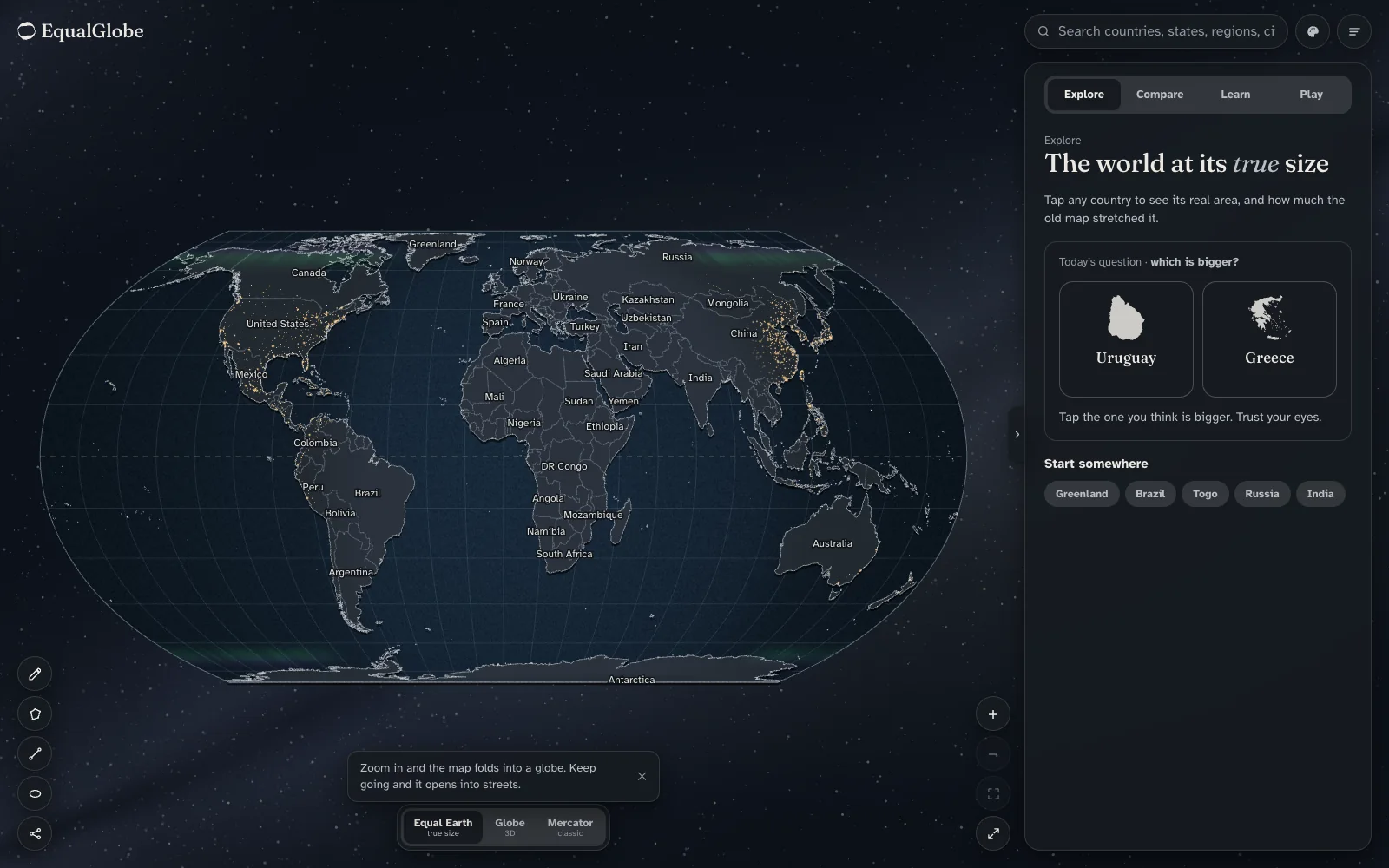
A free, educational world map built on the Equal Earth projection. It folds into a globe, shows what Mercator distorts, and lets you compare countries at their real size. Made for classrooms first, after the UN General Assembly voted in September 2026 to encourage equal-area maps.
Cleap turns a product’s code, database, infrastructure and integrations into one live, zoomable map, so people who build products without reading code can still see how everything fits together.
An open benchmark for one question: given a piece of code, how good is a plain-English description of it? Labels are scored on accuracy, specificity and whether someone who can’t read code would actually understand them. It grew out of Cleap and is at the scaffold stage: a seed set of samples and the scoring pipeline, with real model runs still to come.